2000s EDM Artists: 8 Names and the Tracks to Play
First
The best 2000s EDM artists changed how dance music sounded, traveled, or sold, and eight names tell that story. Tiësto, Paul van Dyk and Armin van Buuren suit you if you want trance. Daft Punk and Justice suit you if you like French electronic music. Benny Benassi gives you one early-2000s club hit. David Guetta suits you if you grew up on radio dance-pop, and Deadmau5 suits you if you want patient, late-decade progressive house.
Most lists of this era blur three decades together. They mix 1990s rave legends with 2010s festival stars, and they skip the fact that "EDM" was rarely the word people used in 2001. Back then you said trance, house, electro or just dance. This list keeps to artists whose defining work landed between 2000 and 2009, and it gives you tracks to start with, so you can rediscover the sound or learn it from scratch.
At RIKIO ROCKS we cover electronic dance music every day. Each pick below explains why the artist mattered and which songs to play first. A short section near the end separates early 2000s acts from late-decade ones.
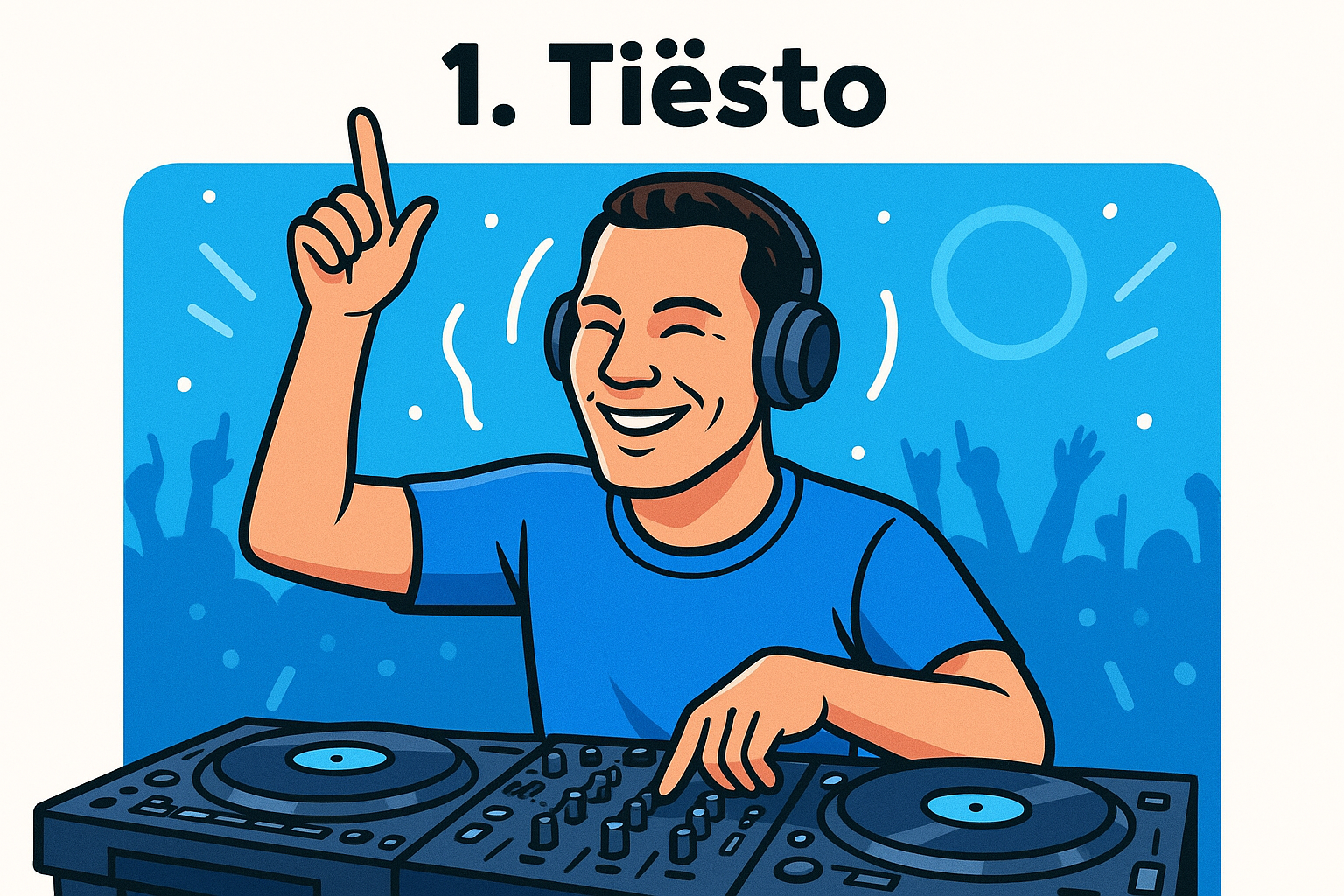
1. Tiësto
Tiësto is the clearest answer to who ruled the early 2000s. He represents the moment trance became a stadium-sized business, and he is the best first listen for anyone who wants that sound.
Why Tiësto defined the decade
The Dutch DJ topped the DJ Mag Top 100 poll in 2002, 2003 and 2004. In 2004 he played the opening ceremony of the Athens Olympics, which put a DJ in front of a global television audience for the first time. His In Search of Sunrise mix series, which started in 2001, gave trance fans a yearly snapshot of where the genre stood.
His sound was melodic, uplifting and built for big rooms. Later in the decade he leaned toward progressive house and pop-friendly vocals, a move that explains why he was still headlining when festival EDM took off. Few trance peers made that jump.
Tiësto turned trance DJing into a stadium-sized career.
Tracks to start with
Start here if you want the most direct route into 2000s trance. These four show his range.
- "Traffic" (2003), a hard, riff-driven instrumental
- "Love Comes Again" (2004, with BT), a vocal trance anthem
- "Just Be" (2004, with Kirsty Hawkshaw), the title track of his vocal album
- "Adagio for Strings," his trance take on Samuel Barber, tied to the Athens era
2. Paul van Dyk
Paul van Dyk is the pick for listeners who want driving, emotional trance with a Berlin accent. He rose in the 1990s, but his biggest poll wins and tours came in this decade.
Why Paul van Dyk defined the decade
The Berlin-based DJ won the DJ Mag Top 100 in 2005 and 2006 and spent the early 2000s on world tours that treated trance as a main-stage genre. His mix album The Politics of Dancing (2001) is a good picture of his style: long, rolling builds with little downtime between tracks.
Van Dyk favored tension over tricks. His records lean on bright synth lines and steady four-on-the-floor drums. That made him a club-friendly trance choice, less sugary than some of his Dutch rivals.
Van Dyk made trance feel like a journey instead of a string of drops.
Tracks to start with
Play these if you want his big vocal records first, then the long-form material.
- "Nothing But You" (2000, with Hemstock & Jennings)
- "Time of Our Lives" (2008, with Vega 4)
- "For an Angel," a 1998 original that stayed in his sets and was reworked again in 2009
- The Politics of Dancing (2001), best heard as one continuous mix
3. Armin van Buuren
Armin van Buuren is the right pick if you want the community side of trance. His radio show built a global fanbase, and his vocal trance reached pop listeners.
Why Armin van Buuren defined the decade
A State of Trance began as a weekly radio show in 2001. It gave listeners around the world a regular place to hear new trance, and it let Armin break tracks by other artists. His A State of Trance mix CDs became a fixture of the decade, with themed discs such as the 2005 light and dark split that Skiddle-style retrospectives still praise.
His chart success arrived later. He took the number one spot in the DJ Mag Top 100 for the first time in 2007 and held it in the following years. He also pushed trance toward vocal songwriting, especially on the 2008 album Imagine.
Armin proved a weekly radio show could build a genre's global community.
Tracks to start with
These tracks cover his club side and his vocal side. If you only play one, make it the Sharon den Adel collaboration.
- "Blue Fear" (2003), a dark, melodic club track
- "Burned with Desire" (2005, with Justine Suissa)
- "In and Out of Love" (2008, with Sharon den Adel), his biggest crossover vocal
- Any A State of Trance mix CD from 2005 to 2007
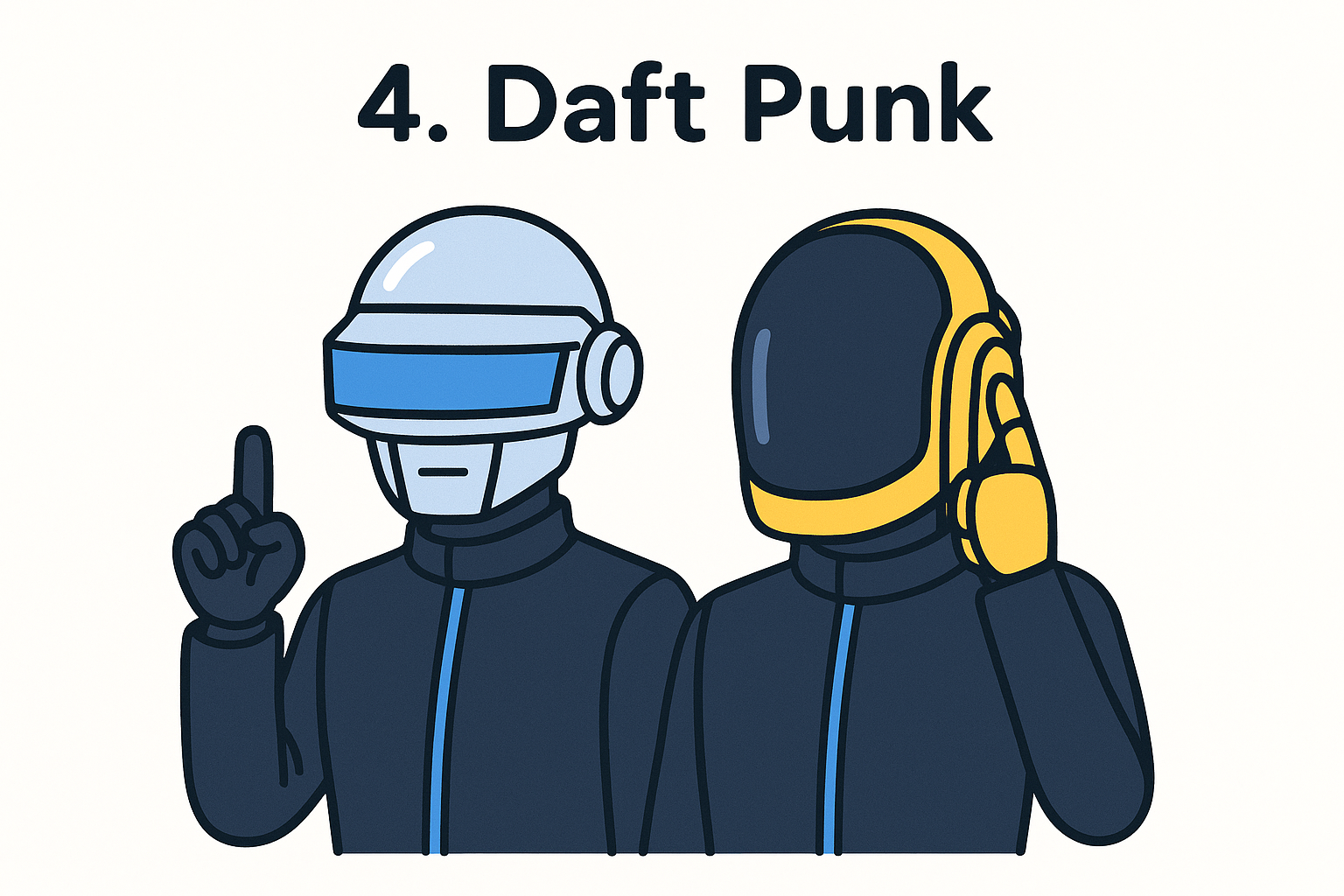
4. Daft Punk
Daft Punk suits you if you want electronic music with songs, jokes and a sense of occasion. They are the most influential act on this list outside trance.
Why Daft Punk defined the decade
The French duo of Thomas Bangalter and Guy-Manuel de Homem-Christo released Discovery in 2001, an album that mixed house beats with disco samples, talk-box vocals and pop hooks. It pulled in listeners who had never visited a club. The robot helmets also meant the music, not the faces, got the attention.
Their live reputation grew just as fast. The pyramid stage show from their 2006 and 2007 tours is widely cited as the moment American audiences took electronic acts seriously as headliners. The live record Alive 2007 won the Grammy for Best Electronic/Dance Album in 2009.
Daft Punk showed that a dance record could work as a full album and a full concert.
Tracks to start with
Discovery is the core of this list. Add the rougher 2005 album if you like your robots abrasive.
- "One More Time" (released in late 2000)
- "Digital Love" (2001)
- "Harder, Better, Faster, Stronger" (2001)
- "Robot Rock" (2005, from Human After All)
5. Benny Benassi
Benny Benassi is the pick for anyone who wants the early-2000s club sound in one record. His career rests on a single hit, but it was a very big one.
Why Benny Benassi defined the decade
The Italian producer released "Satisfaction" in 2002 under the name Benny Benassi presents The Biz. By 2003 its stripped, mechanical electro house groove and its chopped vocal hook had spread through clubs, television and early internet culture. It was one of the first dance tracks that people shared as a clip.
The track's design is the lesson. A hard bassline, a simple pattern, almost no melody. It pointed the way to the harder club sounds that came later in the decade, and many electro producers cite it as a starting point. His 2003 debut album, Hypnotica, carries the same sound across a full record.
Benassi's "Satisfaction" is the template for minimalist electro house.
Tracks to start with
Benassi is a short list, which is fine. Play these in order.
- "Satisfaction" (2002), the record that made his name
- Hypnotica (2003), his debut album, for the rest of the sound
- The video for "Satisfaction," which is part of the track's legacy
6. Justice
Justice is the pick if you like your dance music loud, distorted and a little rock and roll. They are the best way into the late-2000s French scene.
Why Justice defined the decade
The Paris duo of Gaspard Augé and Xavier de Rosnay broke through with their remix of Simian's "We Are Your Friends," released as Justice vs Simian in 2006. It became a club and indie-disco staple. Their debut album Cross followed in 2007, with overdriven synths and sampled choirs that sounded closer to a rock record than to a house set.
They released on the Paris label Ed Banger, which gave the scene a recognizable look and attitude. Justice helped bring guitar-band listeners onto dance floors and made the "blog house" sound of the late 2000s feel like a movement rather than a genre.
Justice made electronic music sound like a rock band at full volume.
Tracks to start with
Start with the single that got everyone's attention, then play Cross as an album.
- "We Are Your Friends" (2006, Justice vs Simian)
- "D.A.N.C.E." (2007)
- "Genesis" (2007)
- Cross (2007), best heard in order
7. David Guetta
David Guetta suits you if your memory of 2000s dance music comes from the radio. He is the bridge between club tracks and the pop charts.
Why David Guetta defined the decade
Guetta started in Paris in the 1980s and spent the early 2000s as a club promoter and producer, including his "F*** Me I'm Famous" parties. His tracks "Love Is Gone" (2007) showed he could write a dance hit with real vocal hooks. The breakthrough came in 2009 with the album One Love.
One Love paired him with pop and R&B vocalists. "When Love Takes Over" featured Kelly Rowland and "Sexy Bitch" featured Akon. He also co-produced the Black Eyed Peas' "I Gotta Feeling" the same year. That run set the template for pop-EDM in the 2010s.
Guetta's 2009 run turned dance producers into pop hitmakers.
Tracks to start with
These are the songs that put his name on radio playlists. The first two are the ones that still work in a club.
- "Love Is Gone" (2007)
- "When Love Takes Over" (2009, feat. Kelly Rowland)
- "Sexy Bitch" (2009, feat. Akon)
- "I Gotta Feeling" (2009, Black Eyed Peas, co-produced by Guetta)
8. Deadmau5
Deadmau5 is the pick for listeners who want patient, technical electronic music. He arrived in the middle of the decade and defined its end.
Why Deadmau5 defined the decade
Joel Zimmerman, the Canadian producer behind the mouse head, released his first album in 2005 and broke out with Random Album Title in 2008. His approach was slow-building progressive house: long arrangements, tension over impact, and tight sound design. He was also open about his production methods, which made him a model for bedroom producers.
His live shows set a new standard for visuals. The mouse head became one of the most recognizable images in dance music, and his stage production influenced the festival spectacle that dominated the early 2010s.
Deadmau5 made long, patient progressive house a headline sound.
Tracks to start with
Play these three to hear how his style went from club tracks to long-form pieces.
- "I Remember" (2008, with Kaskade)
- "Ghosts 'n' Stuff" (2008, feat. Rob Swire)
- "Strobe" (2009), a track of more than ten minutes
- For Lack of a Better Name (2009), the album that contains "Strobe"
How early 2000s EDM artists differ from late-decade acts
Early 2000s EDM artists worked in trance, big beat and French house. Late-decade acts moved toward electro, blog house and pop collaborations. Knowing the split helps you choose the right artist for your mood.
Early 2000s: trance, French house and the first club hits
From 2000 to about 2004, the DJ was the star and the DJ Mag poll was the scoreboard. Trance led the way with Tiësto, Paul van Dyk and Armin van Buuren, while Daft Punk and Benny Benassi brought house and electro to wider audiences. Albums and mix CDs were the main format, and radio shows such as A State of Trance kept the scene together.
Late 2000s: electro, blog house and pop crossovers
From about 2006, the sound got harder and more personal. Justice, Deadmau5 and others built a blog-house and electro wave, and Guetta's 2009 pop collaborations brought producers to the charts. This set up the 2010s boom, when artists such as Skrillex and Avicii would take over. The table puts all eight in one place.
|
Artist
|
Era
|
Core sound
|
Key 2000s marker
|
|
Tiësto
|
Early
|
Trance
|
DJ Mag No. 1 in 2002 to 2004
|
|
Paul van Dyk
|
Early to mid
|
Trance
|
DJ Mag No. 1 in 2005 and 2006
|
|
Armin van Buuren
|
Early to late
|
Trance
|
A State of Trance (2001), DJ Mag No. 1 in 2007
|
|
Daft Punk
|
Early
|
French house, disco
|
Discovery (2001)
|
|
Benny Benassi
|
Early
|
Electro house
|
"Satisfaction" (2002)
|
|
Justice
|
Late
|
Electro, blog house
|
Cross (2007)
|
|
David Guetta
|
Late
|
Dance-pop
|
One Love (2009)
|
|
Deadmau5
|
Late
|
Progressive house
|
"Strobe" (2009)
|
The early 2000s belonged to trance DJs, and the late 2000s belonged to electro and pop crossovers.
More 2000s names worth adding to your playlist
Eight picks cannot cover a decade. If you finish this list and want more, these artists fill the gaps.
- Paul Oakenfold, whose "Ready Steady Go" (2002) was a big progressive-trance hit
- Darude, whose "Sandstorm" reached listeners worldwide around 2000
- Fatboy Slim, whose "Weapon of Choice" (2001) won six awards at the VMAs
- Basshunter, whose "Now You're Gone" (2008) was a pop-dance hit
- Kaskade, a house producer and Deadmau5's partner on "I Remember"
Your next listen after 2000s EDM
The best 2000s EDM artists left a clear trail. Tiësto, Paul van Dyk and Armin van Buuren built trance into a global scene, Daft Punk and Benny Benassi showed what a single album or track could do, and Justice, David Guetta and Deadmau5 pointed the way to the 2010s. Pick one artist from the table above, play the tracks listed, and follow the sound from there.
If you want to hear how that energy carries into today's dance music, try the CARDIO HITS 2026 playlist on Spotify, and keep checking RIKIO ROCKS for daily EDM news.
18