Spanish EDM Artists: Who to Hear in 6 Different
Sounds
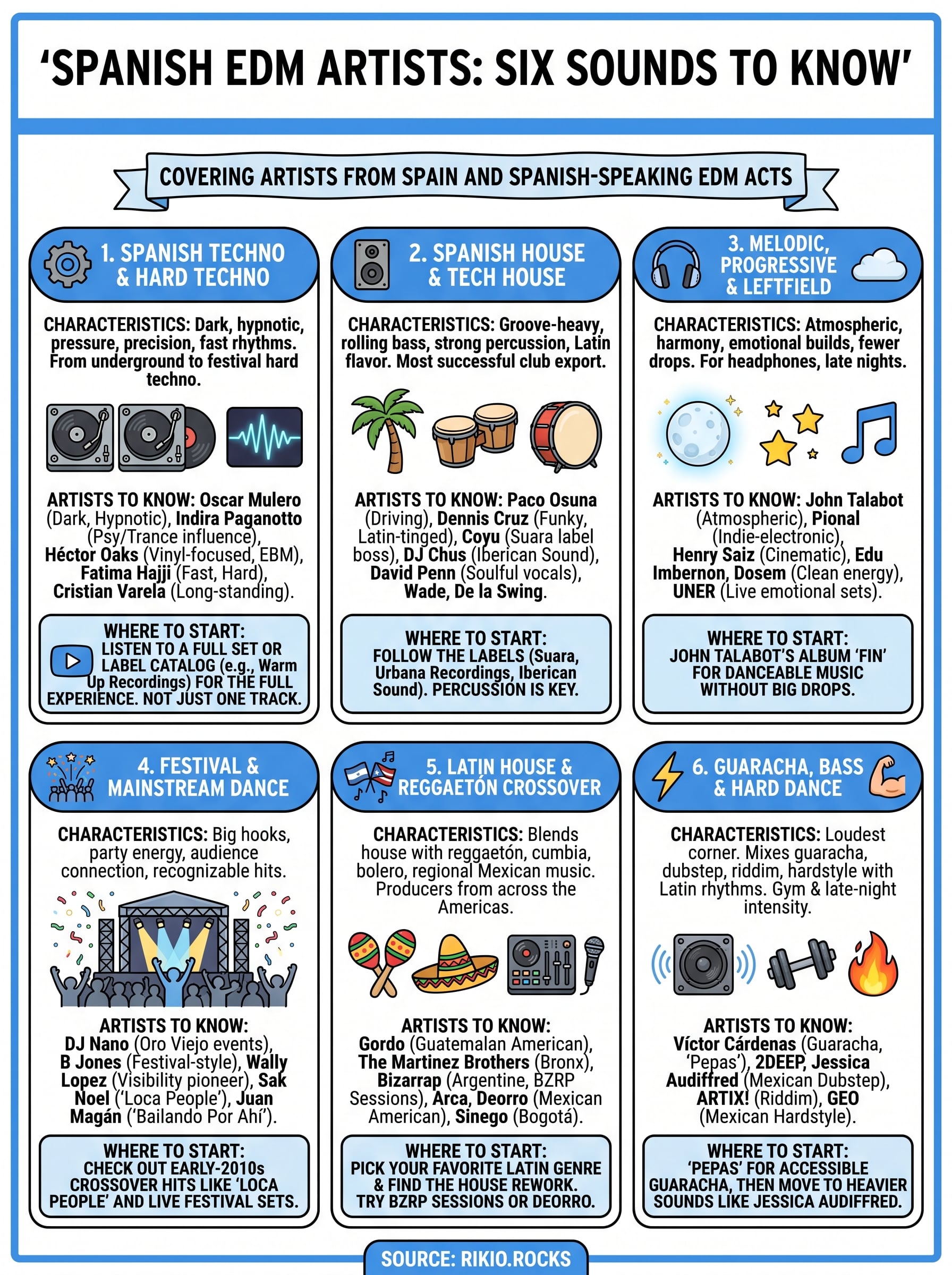
The best Spanish EDM artists fall into six distinct sounds, and the right starting point depends on what you like. Pick Oscar Mulero for dark, hypnotic techno, Dennis Cruz or Coyu for groove-heavy tech house, and John Talabot for late-night melodic house. If you want Latin crossover, Gordo and Bizarrap blend house and reggaetón. For heavy bass and hardstyle with Mexican roots, try Jessica Audiffred and GEO.
Searching for this topic usually returns mixes, playlists and forum threads, each covering one slice. The word "Spanish" also does double duty. It can mean artists from Spain, or Spanish-speaking and Latin American artists who work in electronic music. Most lists pick one meaning and ignore the other, which leaves you with half the picture.
This guide covers both. It groups more than 30 artists into six sounds, and every group has the same two parts: who to know and where to start listening. At RIKIO ROCKS we follow the EDM scene every day, so the picks lean toward artists with a clear identity and a catalog you can dig into.
1. Spanish techno and hard techno
Spanish techno runs from Madrid's late-1980s underground to today's festival-sized hard techno, and the common thread is pressure and precision. Choose this sound if you want Spanish DJ techno with real weight, from slow and hypnotic to fast and punishing.
Artists to know
These five names cover the full intensity range of the scene. All of them are artists from Spain, not foreign DJs who simply play Spanish clubs, so the list is a fair picture of the home-grown techno sound.
-
Oscar Mulero: a central figure in Spanish techno whose career reaches back to Madrid's late-1980s underground. He runs the labels Warm Up Recordings and PoleGroup. His sound is dark, detailed and hypnotic.
-
Indira Paganotto: combines techno with psychedelic and trance influence. Her high-energy style moves between underground clubs and major festival stages.
-
Héctor Oaks: a Madrid-born DJ, producer and label owner known for fast techno and vinyl-focused sets, with rave and EBM influence.
-
Fatima Hajji: a hard techno DJ built around fast rhythms and forceful percussion.
-
Cristian Varela: one of Spain's longest-standing techno names, active as a DJ, producer and live performer.
Where to start listening
Techno rewards long sets and label catalogs more than single hits, so begin with a full hour of an artist rather than one track. Match your mood to the name below, then follow the artist's label or live recordings from there.
- Late-night focus: Oscar Mulero, through Warm Up Recordings and PoleGroup releases.
- Fast, vinyl-style energy: Héctor Oaks.
- Peak-time force: Fatima Hajji.
- Trance-tinged festival drive: Indira Paganotto.
Spanish techno is best judged by a full set, not by one track.
2. Spanish house and tech house
Spanish house and tech house is the country's most successful club export, built on percussion, rolling bass and Latin-flavored grooves. If a friend asks for famous Spanish DJs, this is the sound they usually mean.
Artists to know
Ibiza shapes this scene, but playing Ibiza does not make a DJ Spanish. Maceo Plex, for example, works deep inside the Spanish club circuit yet is not a Spanish DJ, so he is left out. The artists below come from Spain and define the groove-led club sound.
-
Paco Osuna: an internationally established club DJ known for driving techno and tech house, precise mixing and close ties to Ibiza.
-
Dennis Cruz: strong percussion, rolling basslines, funk, dub and Latin influence.
-
Coyu: Barcelona-born DJ and producer who founded the label Suara, bridging tech house and techno.
-
DJ Chus: Madrid-born house veteran tied to the Iberican Sound, which mixes tribal, Latin and progressive percussion.
-
David Penn: soulful vocals and polished grooves, closely linked to Urbana Recordings.
-
Wade and De la Swing: Wade makes direct, vocal-hooked tech house. De la Swing makes groove-led club music tied to Barcelona and Elrow.
Where to start listening
Labels make the easiest on-ramp to this sound. Each one gives you a consistent taste to follow, so one good discovery leads to ten more.
- Suara: Coyu's taste in underground tech house.
- Urbana Recordings: vocal-led house from David Penn's circle.
- Iberican Sound: DJ Chus and percussion-driven house.
- Dennis Cruz releases: funky, Latin-tinged tech house.
In Spanish house, the percussion is the identity, so follow the label, not just the name.
3. Melodic, progressive and leftfield
Spain's melodic and leftfield artists trade drops for atmosphere, harmony and slow emotional builds. Start here if you want Spanish electronic music for headphones, late nights or long drives rather than peak-time floors.
Artists to know
This group is smaller and less obvious than the club names, and it shows that Spanish EDM is not only hard or groovy. Each artist below has a recognizable, personal sound.
-
John Talabot: Barcelona artist known for atmospheric house and leftfield dance music with emotional detail. He often skips conventional drops.
-
Pional: producer, DJ, vocalist and multi-instrumentalist who leans melodic and indie-electronic.
-
Henry Saiz: progressive, melodic and cinematic club music with long arrangements and live performance.
-
Edu Imbernon: blends melodic house, techno and indie-electronic influence, rooted in Valencia's electronic heritage.
-
Dosem: polished techno and progressive house with clean low end.
-
UNER: a live artist working in melodic house and techno with emotionally structured tracks.
Where to start listening
Begin with John Talabot's album Fin, where the track "Depak Ine" shows how restrained, danceable music without big drops can work. From there, pick by what you want to feel.
- Cinematic, long journeys: Henry Saiz.
- Vocal, indie-leaning warmth: Pional.
- Clean, controlled energy: Dosem.
- Emotional live-style sets: UNER.
If you want Spanish electronic music with feeling, start with Talabot's Fin and branch out.
4. Festival and mainstream dance
Mainstream Spanish dance is the easiest entry point if you want big hooks and party energy over club subtlety. It includes festival DJs, event brands and the crossover singles that put Spanish EDM songs on global radio.
Artists to know
These artists are the most recognizable to casual listeners. Their appeal comes from audience connection and instant hooks, which is a different skill from deep club programming.
-
DJ Nano: one of the best-known names in Spanish dance music. His large Oro Viejo events in Madrid turned nostalgia and Spanish club history into a major live format.
-
B Jones: Ibiza-born DJ and producer whose profile grew through major festivals. Her sound sits closer to energetic EDM and house than to underground techno.
-
Wally Lopez: long-running house DJ, producer and broadcaster who helped establish a visible Spanish house presence in the 2000s.
-
Sak Noel: Spanish producer behind the party anthem "Loca People."
-
Juan Magán: Spanish dance artist known for "Bailando Por Ahí."
Where to start listening
For a quick history lesson, play "Loca People" and "Bailando Por Ahí" back to back. Both are early-2010s Spanish crossover hits that show how Spanish pop language met club beats. Then move to the live side.
- DJ Nano: follow the Oro Viejo events for nostalgic Spanish dance sets.
- B Jones: festival-style sets and big-room house.
- Wally Lopez: progressive and tech house from the European club boom.
Mainstream Spanish dance wins on hooks and crowd energy, so judge it by the live set.
5. Latin house and reggaetón crossover
Latin crossover is where Spanish-language EDM is growing fastest, because producers blend house with reggaetón, bolero, cumbia and regional Mexican music. This is the section for famous Hispanic DJs, with Mexican and Argentine names alongside producers from the Bronx.

Artists to know
The crossover scene crosses borders on purpose. The names below span Guatemala, Argentina, Venezuela, Colombia, Mexico and the Bronx, with a shared habit of putting Latin vocals over club rhythms.
-
Gordo: Guatemalan American producer who worked on Drake's Honestly, Nevermind ("Massive," "Sticky"). He also made "Hombres y Mujeres" with Feid and "Parcera" with Maluma.
-
The Martinez Brothers: a Bronx duo of Puerto Rican descent behind "Química" with Rauw Alejandro and Mr. Naisgai, and "Kilo" with Tokischa.
-
Bizarrap: Argentine producer whose BZRP Music Sessions on YouTube blend trap, reggaetón and regional Mexican music with electronica, including Session No. 52 with Quevedo.
-
Arca: Venezuelan artist whose "KLK" with Rosalía mixes glitchy reggaetón beats with Venezuelan gaita.
-
Deorro: Mexican American DJ who puts house spins on regional Mexican music, as in "Yo Las Pongo" with Los Tucanes de Tijuana and "Dime" with Los Ángeles Azules.
-
Sinego: Bogotá producer known for house bolero, including "Verte Triste" and "No Soy De Aquí."
Where to start listening
Choose by the Latin sound you already love. If you want a Mexican male DJ with festival credits, Deorro is the clear pick. If you want horns and brass in your dance music, regional Mexican crossovers like his are the likeliest place to find them.
- Reggaetón plus house: "Hombres y Mujeres" by Gordo and Feid.
- Club-ready Latin house: "Química" and "Kilo" by The Martinez Brothers.
- Viral Spanish-language beats: BZRP Music Sessions No. 52.
- Bolero and cumbia reworked: Sinego.
For Latin EDM, pick the Latin genre you already love and find the house producer who reworked it.
6. Guaracha, bass and hard dance
Latin bass and hard dance is the loudest corner of Spanish-language EDM, mixing guaracha, dubstep, riddim and hardstyle with Latin rhythms. It suits listeners who want gym, festival or late-night intensity.
Artists to know
This group shows how Latin culture entered heavy electronic genres. Each artist keeps a regional rhythm at the center of the production, so the music stays recognizable even at high BPM.
-
Víctor Cárdenas: Colombian guaracha producer whose "Baila Conmigo" hit No. 1 on Billboard's Dance Club Songs chart in 2019 after Jennifer Lopez covered it. He also produced Farruko's "Pepas."
-
2DEEP: Bronx DJ of Ecuadorian and Colombian descent who mixes reggaetón and guaracha, with tracks like "Guaracha En Reggaetonlandia" and "Takataka."
-
Jessica Audiffred: a Mexican dubstep DJ behind "Rise" with Excision and Leah Culver and "Trippin'" with ARTIX! She brought dubstep to the mainstage at EDC Mexico.
-
ARTIX!: Argentine riddim producer who blends in cumbia. His tracks include "SUELTA EL RITMO" with DEUCEZ.
-
GEO: Mexican American hardstyle DJ who fuses fast, heavy kicks with corridos and cumbias. Try "Tetris," "Controlando" and "Cold War."
Where to start listening
Begin with "Pepas," the most accessible bridge between guaracha and mainstream dance. Then step into the heavier names depending on your taste, since this sound gets harder quickly.
- Gateway guaracha: "Pepas," produced by Víctor Cárdenas.
- Bass-heavy dubstep: "Rise" by Jessica Audiffred.
- Cumbia-flavored riddim: ARTIX!
- Mexican hardstyle: GEO's "Tetris."
Heavy Latin dance keeps its regional rhythm at the center, even at the highest BPM.
Where to go from here
Spanish EDM covers six sounds, and they point to different listeners. Techno and hard techno suit late nights, house and tech house suit dance floors, melodic artists suit headphones, and festival names offer instant hooks. Latin crossover and bass artists bring Spanish-language vocals and regional rhythms into electronic music. Start with one name per section, follow the label or collaborations that appeal to you, and the rest of each scene opens up fast.
If you want high-energy tracks to keep going between discoveries, try the CARDIO HITS 2026 playlist on Spotify. For news on new releases, festivals and emerging DJs, keep an eye on RIKIO ROCKS.
1